
Intro
Most text to video clips fail before they are generated. The idea is fine, but the words given to the model are vague, and the model has to guess the rest. That guess is where strange faces, drifting cameras and empty scenes come from. An ai video prompts generator for text to video fixes this by structuring your idea before you generate.
An ai video prompts generator for text to video removes that guesswork. You type your idea in plain words, and it shapes it into a structured shot brief the model can actually follow.
In this guide, you will learn what an ai video prompts generator for text to video does, how to use it step by step, and how to fix a weak result. One full worked example takes a single idea from a plain sentence to a finished prompt.
What the AI Video Prompts Generator Is and What It Does for Text to Video
An ai video prompts generator for text to video is a simple tool that turns a rough idea into a complete video prompt. You describe the scene you want, and it writes the prompt in the order video models understand best: subject first, then action, then setting, camera, lighting and style.
That order matters more than most people realise. A text to video model builds a clip from words alone, with no photo to anchor it. If the words are scattered, the clip is scattered too. A clear order gives the model one subject, one action and one camera move to hold on to, which is exactly what an ai video prompts generator for text to video enforces.
The ai video prompts generator for text to video on VideoPromptsPro is built for exactly this job. You describe what you want, choose your model, and it gives you a clean prompt to paste into your video tool. It does not replace your creativity. It organises it, so the model renders the scene you pictured instead of a random version of it.
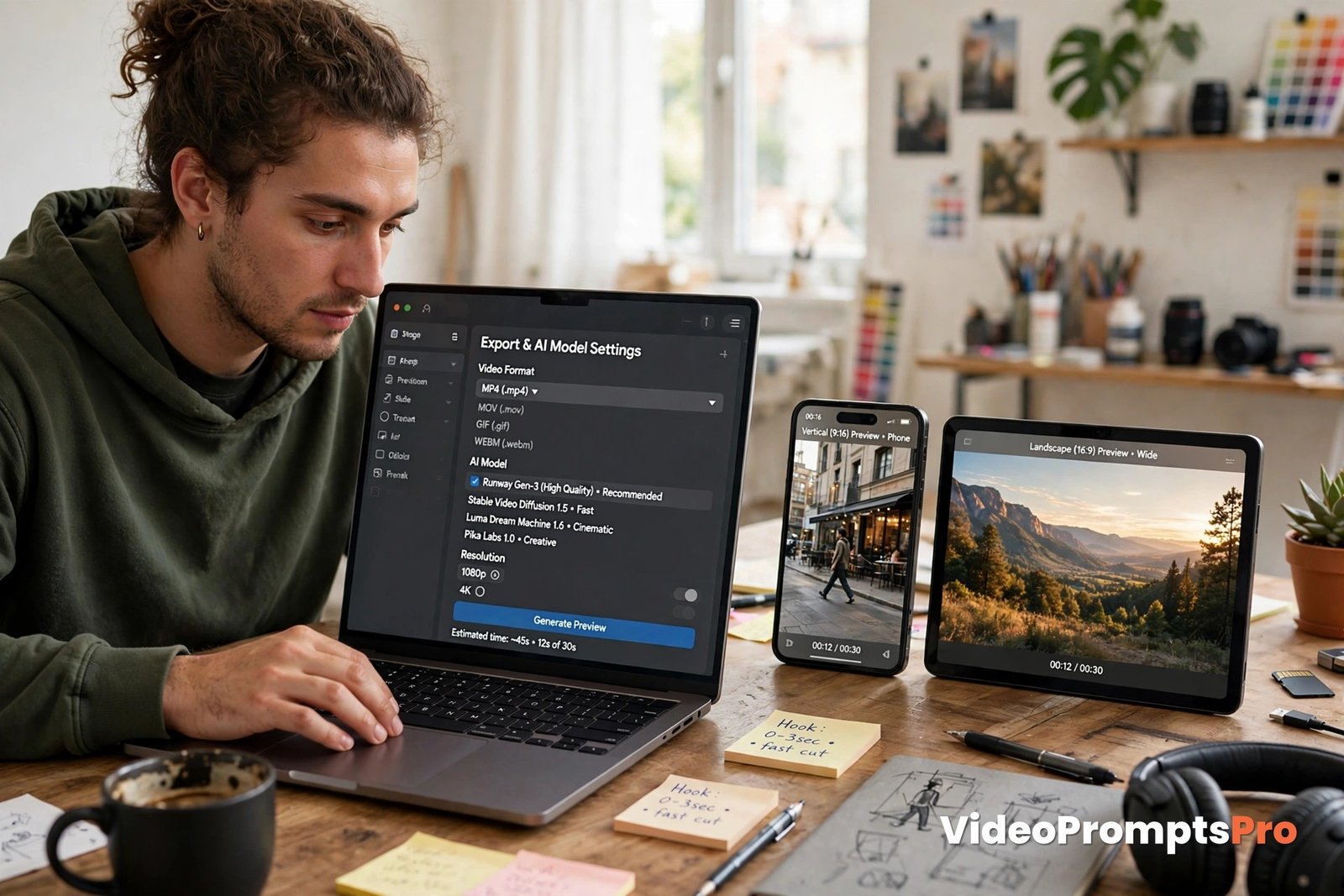
The Supported AI Models are Flow, Grok, Veo 3, Gemini, Sora and Kling. Each one reads prompts a little differently. Flow, powered by Veo 3, handles dialogue, sound and realistic human movement well. Kling keeps human motion smooth, Sora leans cinematic, Gemini is fast for quick tests, and Grok is useful when you want a bold, stylised look. Picking the model before you write matters, because a prompt written for a cinematic model may need trimming for a fast short form model. An ai video prompts generator for text to video helps you pick the model before you write, so the prompt fits from the start.
Why does text to video need its own approach? Because there is no starting image to do the hard work. In image to video, the photo fixes the face, the product and the colours. In text to video, every one of those details must come from your words, or the model invents them. An ai video prompts generator for text to video makes sure nothing important is left to chance: the subject, the action, the setting, the camera and the light are all named before you generate.
Format comes first, not last. A vertical 9:16 clip needs its subject centred and framed tall, while a wide 16:9 clip can breathe with space on the sides. If you write a wide scene and then crop it vertical, the subject often ends up half out of frame. Decide the platform and the ratio before you describe the scene, and an ai video prompts generator for text to video will frame the shot correctly from the start.
How to Use the AI Video Prompts Generator for Text to Video Step by Step
Using an ai video prompts generator for text to video takes a few minutes, and most of that time should go into thinking, not typing. A clear idea in, a clear prompt out. Follow these steps in order.
Step 1: Write your idea in one plain sentence. Start with what the viewer should see happen, not with background story. “A bookshop owner opens his shop in the rain” is a usable idea. “A man who loves books and has run a shop for years” is backstory, and the model cannot film backstory. An ai video prompts generator for text to video works best when the idea is one clear, filmable action.
Step 2: Choose the model and the format. With an ai video prompts generator for text to video, pick the model that fits the job, then set the ratio and the length. A 5 to 8 second clip can hold one action well. A longer clip needs a simpler action, or the motion starts to fall apart halfway through.
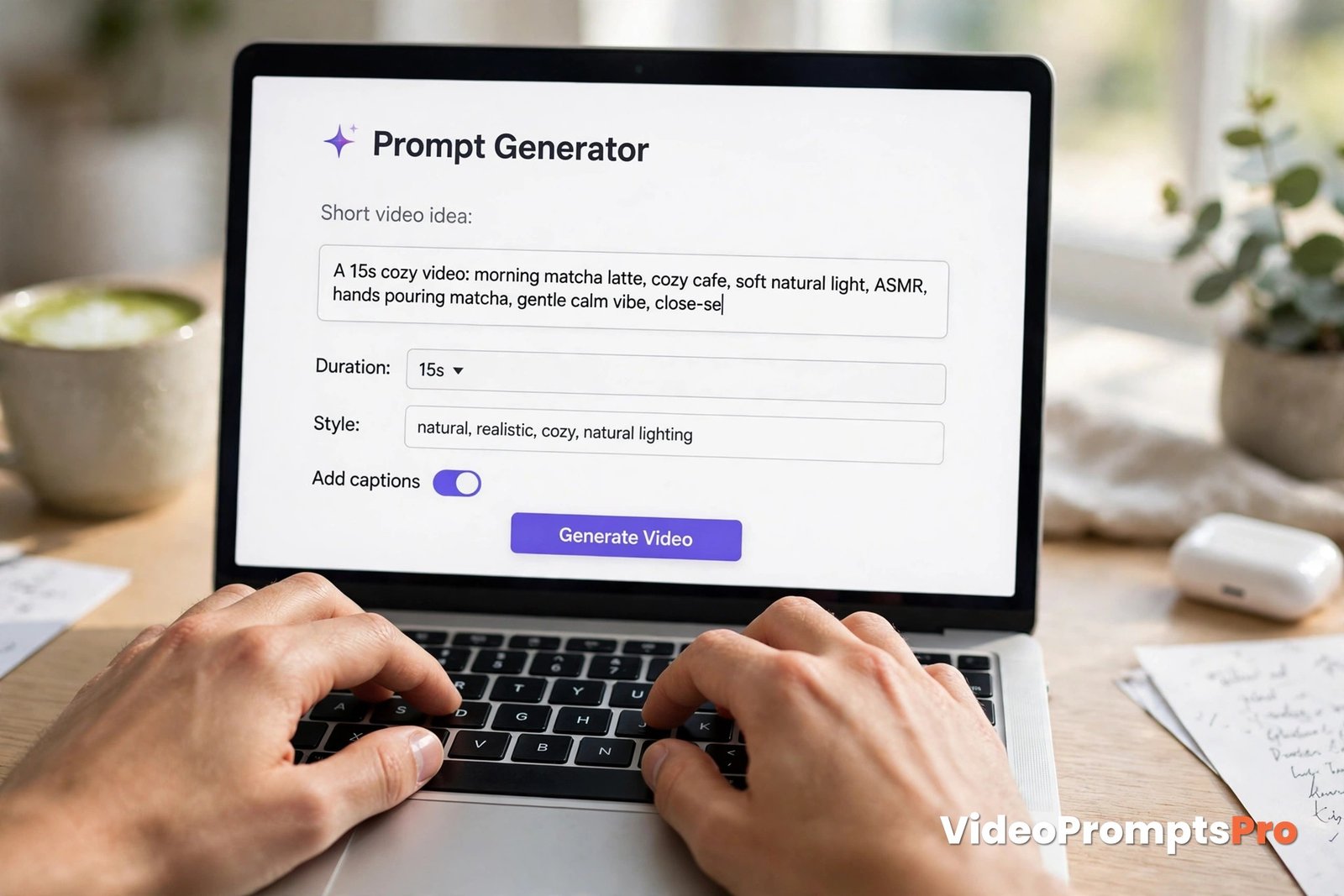
Step 3: Fill in the shot brief fields. An ai video prompts generator for text to video asks for the building blocks of the shot: subject, action, setting, camera, lighting and style. Answer each one in short, visible terms. Name what the camera sees, not what the character feels. “Warm light through the shop window” works. “A feeling of nostalgia” does not, because the model cannot see a feeling.
Step 4: Read the prompt before you paste it. Check three things. Is there one main action, or three competing ones? Is the camera move named, or left vague? Is anything in the prompt contradicting something else, like a “static camera” with a “fast tracking shot” in the same sentence? Fix contradictions now, not after a wasted generation.
Step 5: Generate, watch twice, and change one thing. Watch the clip once for the overall feel and once for the details. Then change only the biggest problem and generate again. Changing five things at once teaches you nothing about which change fixed the clip. A good prompting guide makes the same point about treating the prompt like a director’s brief, with one subject, one action and one camera direction per clip, as explained in Renderforest’s guide to effective text to video prompts. An ai video prompts generator for text to video applies the same director’s-brief discipline automatically.
Step 6: Save what worked. When an ai video prompts generator for text to video gives you a clip you like, save the exact wording. Small wording changes can shift a result a lot, and a saved prompt is a starting point you can reuse for the next scene in the same style.
One Full Worked Walkthrough Example
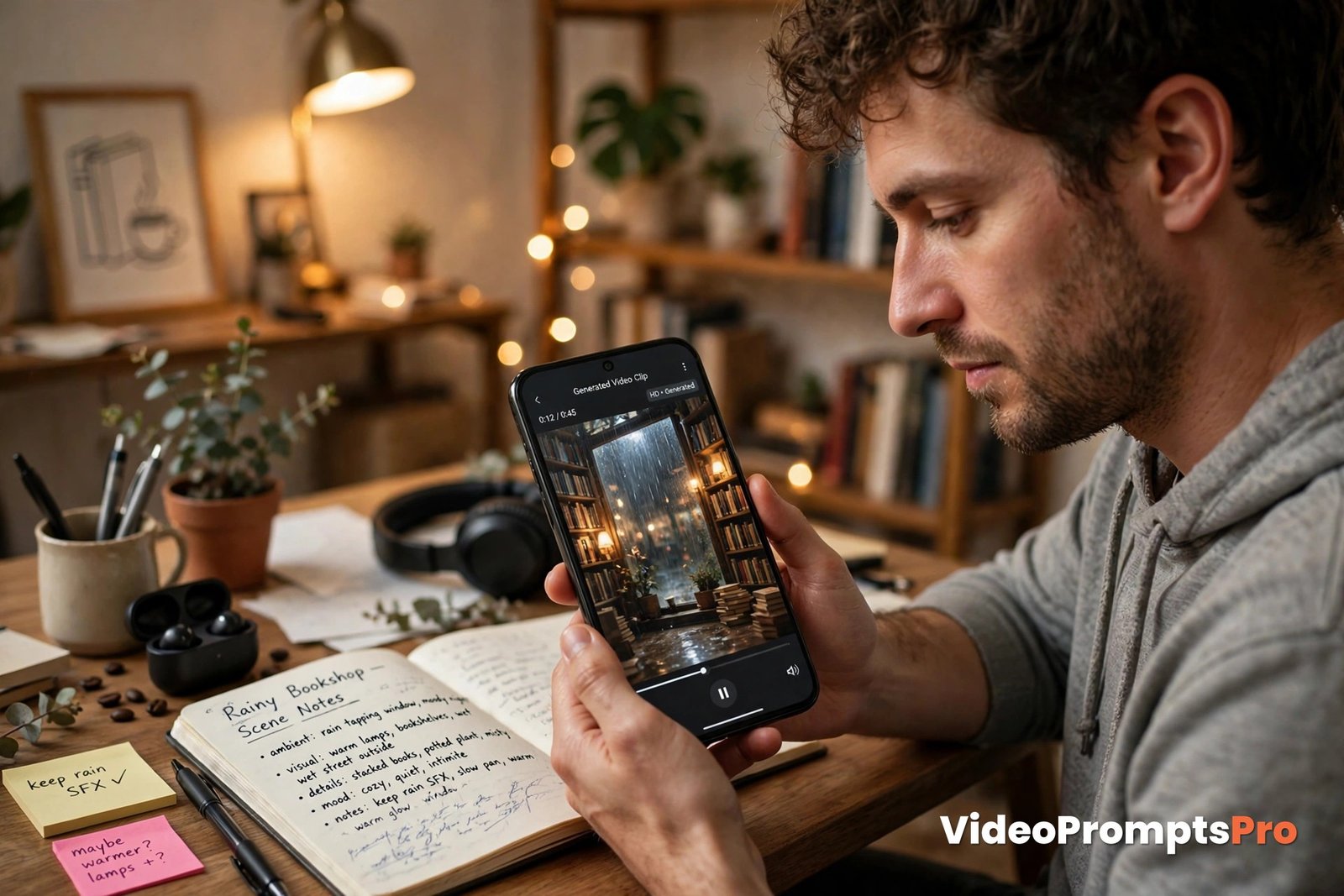
Here is the whole process with one idea, so you can see how an ai video prompts generator for text to video turns a plain sentence into a usable prompt. The idea is simple: a bookshop owner opening his shop on a rainy evening.
The plain sentence is: “A bookshop owner opens his shop in the rain.” It is a fine idea, but as a prompt it leaves too much open. Who is the owner? What does the shop look like? Where is the camera? The generator fills those gaps by asking for the shot brief fields, and the finished prompt looks like this:
An elderly bookshop owner in a brown coat unlocks the wooden door of his small bookshop on a quiet street at dusk, warm light glowing through the shop window as rain falls gently around him. He steps inside and switches on a lamp. Slow push-in camera, shallow depth of field, cinematic, warm golden light against cool blue rain, 16:9, no text, no extra people.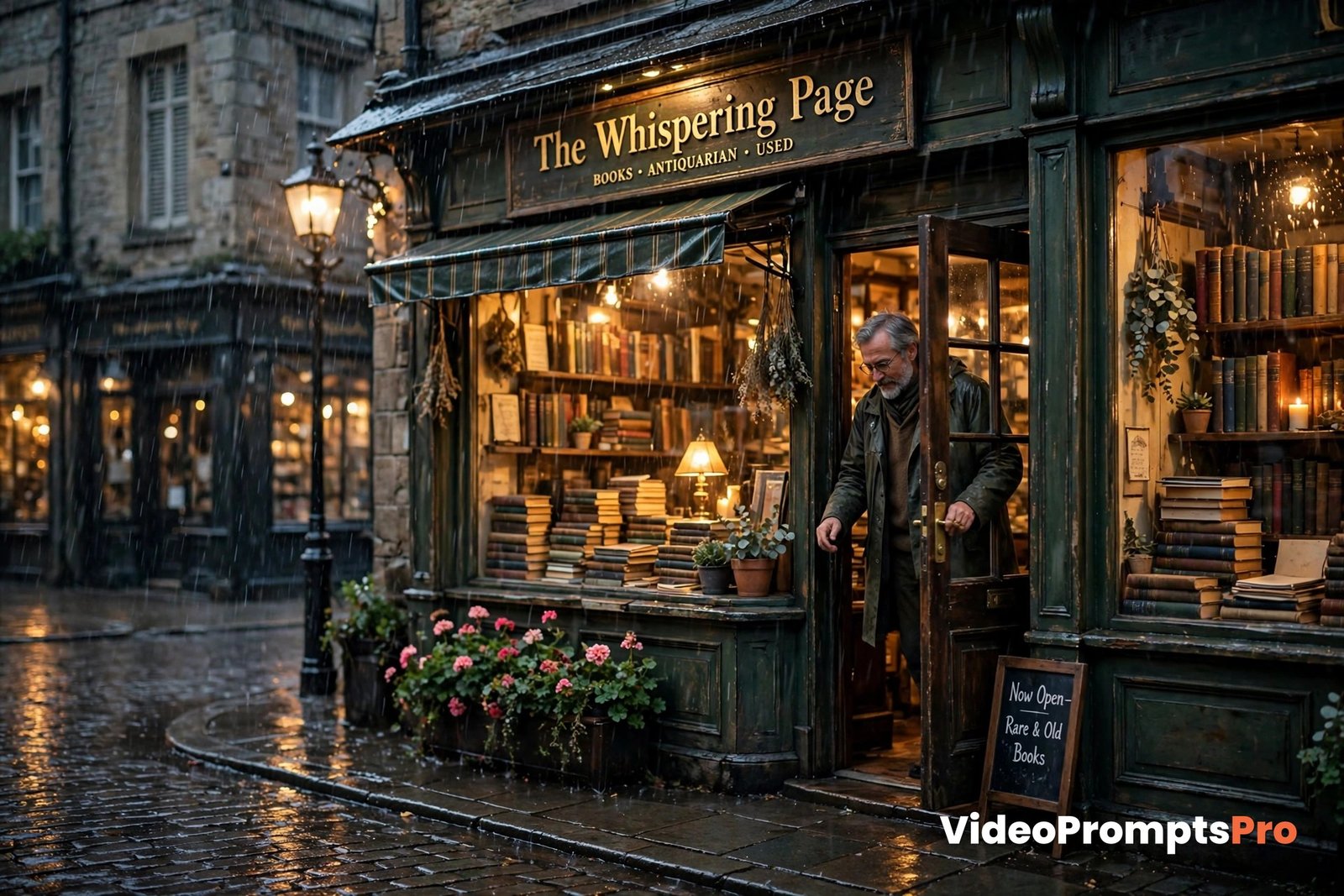
Notice what the prompt from an ai video prompts generator for text to video does. It keeps one main action, unlocking and entering the shop, and lets the rain and the lamplight do the atmosphere work. The camera move is named, the light is named, and the ratio is set. Nothing in it fights anything else.
Now suppose the first clip comes back with the camera moving too fast. The fix is one line, not a rewrite: change “slow push-in camera” to “static camera at street level”. Generate again and compare. If the rain looks too heavy, soften it to “light drizzle” and keep everything else the same. This one-change-at-a-time habit is the fastest way to learn what each word in your prompt actually controls.
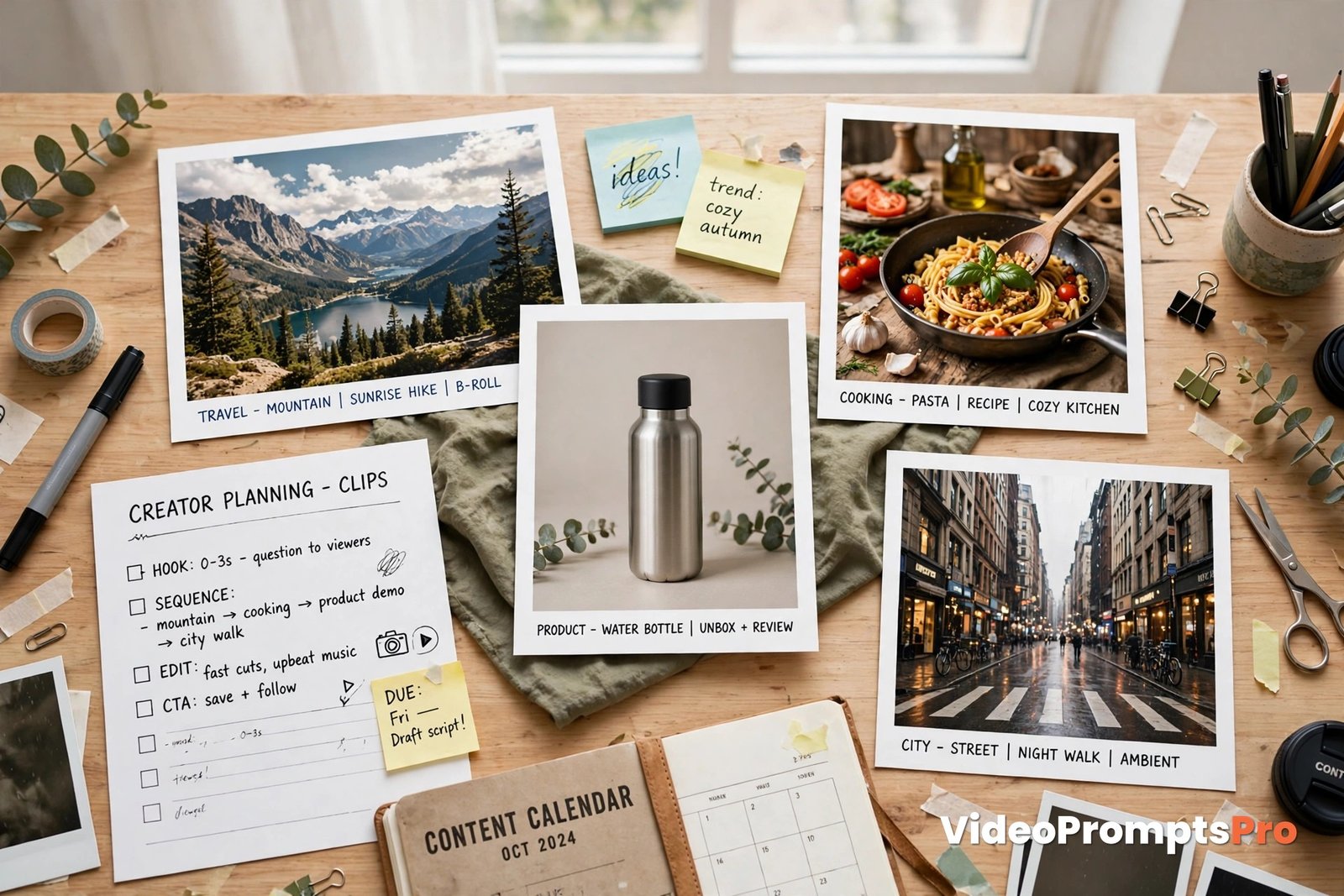
With an ai video prompts generator for text to video, you can adjust the same prompt for other formats without starting over. For a vertical short, keep the subject centred and shorten the action to the door opening alone. For a product style clip, swap the bookshop for a product on a table and keep the same camera and lighting structure. The structure travels, the subject changes.
Text to Video Strengths and Limits for Video Prompts
Text to video is at its best when the scene does not exist yet. You can film a rainy bookshop street, a mountain sunrise or a futuristic workshop without a camera, a location or a budget. It is also the fastest way to test an idea with an ai video prompts generator for text to video, because a new scene costs a sentence, not a shoot.
It is also honest about its limits. Faces can drift between clips, hands can look wrong, and on-screen text often comes out garbled. That is why the prompt should say “no text” unless readable text is essential, and why one clip should hold one action. Asking a single 8 second clip to show a character arriving, sitting down, opening a laptop and answering a call is asking for four clips in one, and the model will compress them into a blur.
Duration is a limit too, and it varies by model. Short clips are more reliable than long ones, and a series of short, well planned shots edited together usually beats one long, wandering generation. Plan your video as shots, not as a single paragraph, and an ai video prompts generator for text to video becomes a shot list tool as well as a prompt tool.
Sound is another place to check the model first. Some models support native audio and dialogue, while others generate silent video. If your clip needs dialogue, write it into the prompt only for a model that supports it, and keep the line short. A long speech in a short clip will be cut off or rushed.
Common Mistakes and Fixes
Mistake 1: Too many actions in one clip. The fix is to split the idea. An ai video prompts generator for text to video makes this natural: give each clip one action, then edit the clips together. A sequence of three clean shots always looks better than one crowded one.
Mistake 2: Describing feelings instead of visuals. The fix is to translate the feeling into something visible. Instead of “a sad morning”, write “grey light, empty street, slow rain on an umbrella”. The model films what it can see.
Mistake 3: No camera direction. The fix is to name the shot every time: static, slow push-in, pan left, or tracking shot. Without a camera instruction, the model picks one at random, and the result feels aimless. The AI video prompt guide on structure, motion and model choice puts camera, action and atmosphere in a simple checklist for the same reason.
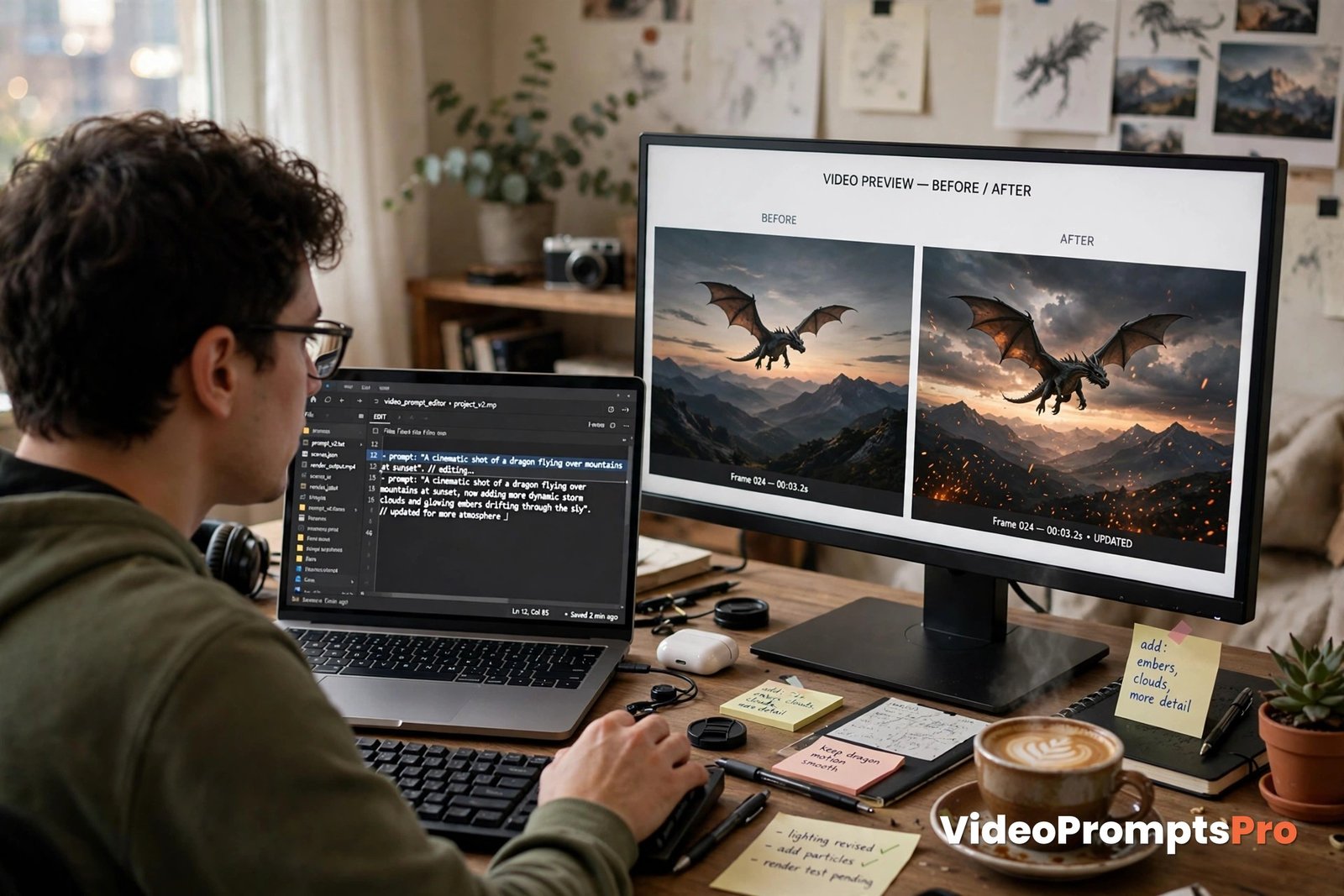
Mistake 4: Changing everything after a bad result. The fix is the one-change rule. With an ai video prompts generator for text to video, note the biggest problem, change that one instruction, and generate again. You will learn the tool far faster, and you will waste far fewer generations.
Mistake 5: Forgetting the constraints. The fix is to end the prompt with what to leave out: no text, no extra people, no flickering. Short negative instructions at the end work better than a long list of things to avoid buried in the middle.
Mistake 6: Writing the prompt for the wrong ratio. The fix is to set the format first. A prompt written for wide framing will not survive a vertical crop, so decide the platform before you describe the scene.
Pro Tips for Better Text to Video Prompts
Start with the ending in mind. An ai video prompts generator for text to video works best when you know the final frame: ask yourself what it should look like, then work backwards to the opening. Clips that end on a clear image feel finished, while clips that simply stop feel like accidents.
Use motion words for everything that moves, including the camera, the subject and the environment. “Hair blowing in the wind, leaves drifting, camera pushing in slowly” gives the model three layers of motion to work with, and the clip feels alive instead of like a moving photo.
Keep a small library of prompts from your ai video prompts generator for text to video sessions that worked for you. When you find a lighting style or a camera move you like, reuse its wording and change only the subject. If you want fresh starting points, the text to video prompt library is a useful place to study how finished prompts are structured.
Test the same prompt on two models before you commit to a series. Models read the same words differently, and one may handle faces while another handles motion better. A quick comparison saves a lot of rework later.
Finally, write for the viewer, not for the model. If a stranger watched the clip with the sound off, would they understand what happened in the first two seconds? If not, the prompt needs a clearer opening action, not more adjectives.
FAQ
What is an ai video prompts generator for text to video?
It is a tool that turns a plain idea into a structured video prompt, with subject, action, setting, camera, lighting and style in the order models understand best.
Do I need a photo to use text to video?
No. An ai video prompts generator for text to video starts from words alone, which is why the prompt must describe the subject, the setting and the camera in full.
How long should a text to video clip be?
Most reliable clips run 5 to 10 seconds and hold one main action. Longer ideas work better as a series of short shots edited together.
Why does my clip look different from my prompt?
Usually one part of the prompt is vague or contradictory. Check the camera move, the main action and the lighting first, then change one instruction at a time.
Which model should I choose for text to video?
Choose by the job. An ai video prompts generator for text to video can target any of them: Flow and Veo 3 suit realistic scenes with dialogue, Kling suits smooth human motion, Sora suits cinematic looks, and Gemini suits fast tests.
Can the generator write prompts for other formats too?
Yes. The same shot brief structure works for vertical shorts, wide YouTube clips and product videos, as long as you set the format before you write.
Is the generator free to try?
Yes, you can try the generator on the VideoPromptsPro homepage and shape your first prompt without signing up for a video tool first.
Conclusion
Good text to video starts with good words. An ai video prompts generator for text to video gives those words a structure, so the model spends its effort rendering your scene instead of guessing it.
With an ai video prompts generator for text to video, start with one plain sentence, set the model and the format, fill in the shot brief, and refine one change at a time. Do that consistently, and your clips will stop looking random and start looking directed.
Open the generator, type your next idea, and generate your first structured prompt today.
SEO Expert & Contant Writer